Winter Geminids Radiant
Among all annual meteor displays, the Geminids provide the most reliable volume and highest total Zenithal Hourly Rate, frequently topping 120 to 150 meteors per hour during their December 13–14 maximum. Unlike almost every other major shower, which traces its genesis to an icy comet, the Geminids originate from an enigmatic rocky asteroid named 3200 Phaethon.
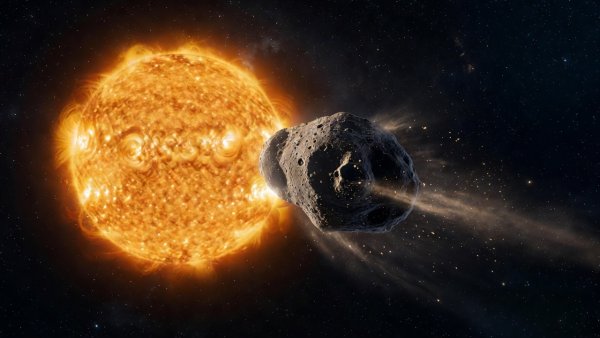
The Rock-Comet Paradox
Discovered in 1983 by the Infrared Astronomical Satellite (IRAS), 3200 Phaethon follows a severely tight orbit that brings it closer to the Sun than any other named asteroid—within just 21 million kilometers (0.14 AU). At perihelion, surface temperatures exceed 750°C, causing thermal fracturing and crustal desiccation that ejects gravel and mineral flakes into space.
Physical Characteristics: Slow and Dense
Because Phaethon is composed of dense silicate rock and iron compounds rather than fluffy comet dust, Geminid particles have a higher bulk density (approximately 2 to 3 g/cm³ compared to 0.3 g/cm³ for comet particles). Furthermore, their orbital geometry intersects Earth at a relatively modest velocity of 35 kilometers per second.
This slower atmospheric passage, combined with higher structural density, allows Geminids to penetrate deeper into Earth's stratosphere—often surviving down to 40 kilometers above sea level before complete ablation. The result is long-burning, intensely colorful arcs displaying yellow, emerald-green, and brilliant sodium-white tones.
Observational Advantage: Early Evening Radiance
The radiant point for the shower sits near Castor (Alpha Geminorum), which rises in the east-northeast immediately following astronomical twilight in mid-December. While most meteor showers demand staying awake until pre-dawn hours, the Geminid radiant achieves solid elevation by 21:00 local time, making evening viewing highly productive for observers across North America and Europe.
Cold-Weather Survival Protocol
Winter stargazing requires rigorous physical insulation. Sub-zero temperatures can shorten camera battery lifespans and lead to rapid hypothermia if observers lie stationary on cold ground. Use insulated sleeping pads with high R-values, wind-impermeable bivvy bags, chemical hand warmers, and lens heater strips to prevent nocturnal frost from condensing across optical elements.