Leonid Fireball History
While standard annual iterations of the November Leonids produce modest zenithal hourly rates around 10 to 15 meteors per hour, the shower occupies a sacred place in the annals of astronomy. Every 33 years, corresponding to the orbital period of parent comet 55P/Tempel-Tuttle, the Leonids can erupt into catastrophic meteor storms with rates exceeding 100,000 meteors per hour.
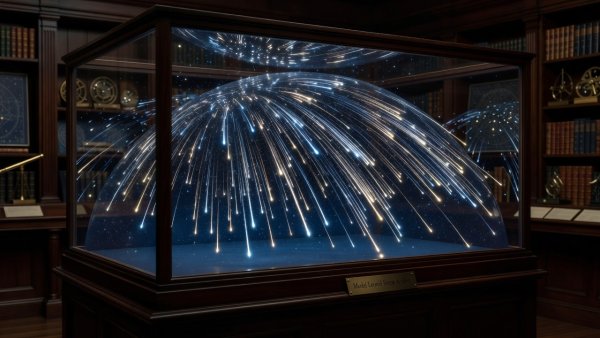
The Great Storm of November 12–13, 1833
On that legendary night across eastern North America, the sky was filled with a deluge of fiery streaks estimated at over 240,000 meteors over a nine-hour period. It was during this event that Yale astronomer Denison Olmsted recognized that the streaks diverged from a common celestial vanishing point in the constellation Leo, proving definitively that meteor showers were cosmic events originating outside Earth's atmosphere.
Maximum Kinetic Energy: The 71 km/s Boundary
Comet 55P/Tempel-Tuttle orbits the Sun in a retrograde direction opposite to the orbital direction of Earth. Consequently, when Earth and the Leonid stream collide, the impact is a direct head-on encounter. Meteoroids smash into our upper atmosphere at 71 kilometers per second (nearly 256,000 km/h)—the theoretical maximum velocity for particles bound to the solar system.
At 71 km/s, even a dust grain with the mass of a single grain of sand packs astronomical kinetic energy (E = ½mv²). The particle vaporizes instantaneously at altitudes between 100 and 115 kilometers, stripping electrons from atmospheric gas molecules and creating brilliant neon-like ionization tubes.
Persistent Smoke Trains
Leonid fireballs frequently generate long-lasting "persistent trains." Unlike the streak of light itself, which disappears in a fraction of a second, these persistent trains consist of warm, glowing metallic atoms (iron, sodium, and magnesium) reacting chemically with ambient ozone. These spectral tubes twist and distort in upper-atmospheric winds for 10 to 30 minutes, visible through binoculars like winding cosmic smoke ribbons.
Current Cycle Prospects
Comet Tempel-Tuttle last passed perihelion in 1998, triggering memorable minor storms between 1999 and 2002. As the comet moves outward toward aphelion near Uranus, current rates remain at baseline levels. However, orbital filament modeling indicates encounters with older, dense dust ribbons shed in 1699 and 1767 could produce brief surges of bright fireballs during current November peaks.